
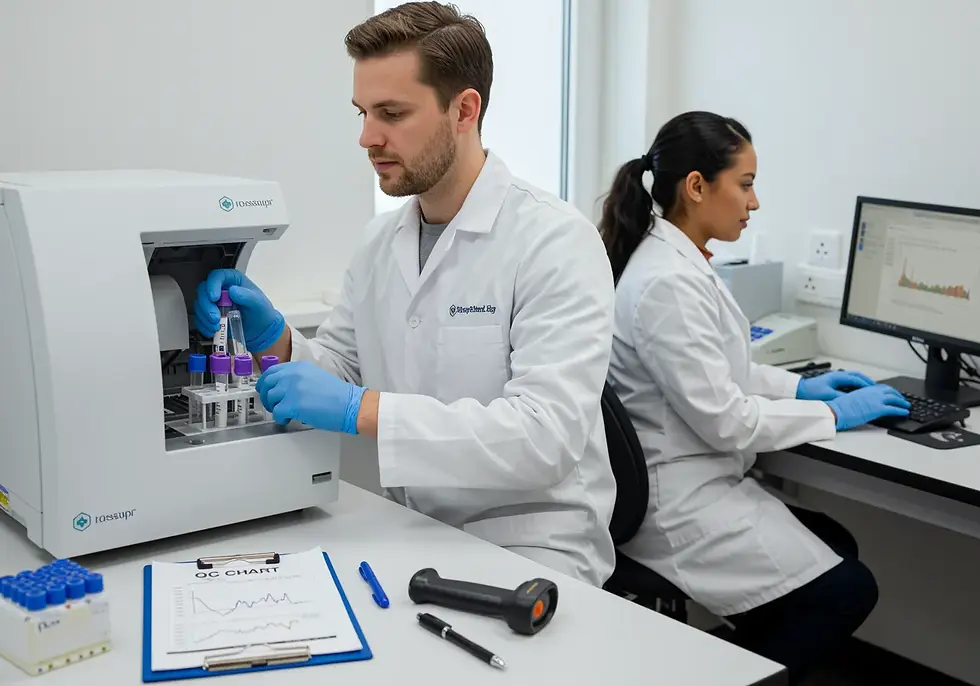


At USALCS, we specialize in laboratory test validation for clinical, molecular, and pathology laboratories seeking accuracy, reliability, and full regulatory compliance. Validation is the foundation of laboratory quality—it confirms that every assay, instrument, and method produces results that are both accurate and reproducible. Without proper validation, even the most advanced testing systems can fail to meet compliance or patient safety standards.
Our experts support laboratories of all sizes, from startup blood labs to established diagnostic centers, in developing and validating test methodologies under CLIA and CAP regulations. Whether you’re implementing a new chemistry panel, PCR assay, or point-of-care test, we ensure your validation studies meet the highest scientific and operational benchmarks.
Our laboratory test validation services cover all critical stages—from pre-validation planning to documentation and regulatory submission. We help laboratories design, execute, and record validation protocols for both qualitative and quantitative lab tests.
Our scope includes:
Method Verification: Confirming that commercial test kits perform as intended under your lab’s specific conditions.
Accuracy & Precision Studies: Measuring repeatability and reproducibility across multiple runs and operators.
Analytical Sensitivity & Specificity: Determining detection limits, cross-reactivity, and interference profiles.
Linearity & Reportable Range Testing: Verifying accurate results across different concentration levels.
Reference Interval Establishment: Setting normal value ranges for your patient population.
Carryover & Contamination Checks: Ensuring assay integrity during high-volume workflows.
Instrument-to-Instrument Correlation: Validating results consistency across multiple analyzers.
Documentation & Summary Reports: Preparing regulatory-ready records for CLIA, CAP, or ISO inspection.
With USALCS, you receive a turnkey validation package designed to minimize downtime, eliminate uncertainty, and guarantee defensible lab results interpretation during audits.
Our validation process is both scientific and structured — designed to align with CLIA, CAP, and FDA guidance. Every laboratory test validation project we manage follows a consistent, evidence-based workflow to ensure accuracy and compliance.
Initial Assessment & Planning: Reviewing lab methods, equipment, and regulatory requirements to determine study scope.
Protocol Development: Drafting validation plans specific to your testing platform and analyte type.
Data Collection: Running test samples under controlled conditions to collect quantitative and qualitative results.
Statistical Analysis: Using industry-standard tools to evaluate precision, bias, and correlation.
Report Compilation: Creating a comprehensive validation report with tables, graphs, and key metrics.
Regulatory Review & Sign-Off: Assisting your director or pathologist with final validation approval for submission.
Inspection Preparation: Providing documentation and training to ensure successful CLIA or CAP audit outcomes.
This process not only secures compliance but also strengthens confidence in every assay performed in your laboratory.
Maintaining compliance isn’t optional—it’s essential. Our laboratory test validation service ensures every test your lab performs adheres to the strictest regulatory standards. Whether you’re a startup facility or a certified clia lab near me, USALCS guarantees every validation meets the highest levels of quality assurance.
Our compliance framework includes:
Alignment with CLIA, CAP, and ISO 15189: Validation plans and documentation that meet all major accreditation body standards.
Proficiency Testing Support: Integrating PT programs to verify ongoing assay performance.
Quality Control (QC) Integration: Establishing daily, weekly, and monthly QC procedures for consistent accuracy.
Training & Competency Evaluation: Teaching staff to perform and document validation procedures properly.
Audit Readiness: Conducting mock inspections and record reviews for peace of mind.
Continuous Monitoring: Implementing post-validation performance checks for long-term reliability.
By prioritizing quality from the start, your laboratory test process remains compliant, defensible, and efficient under any inspection or accreditation review.
Q1: Why is laboratory test validation necessary?
It ensures that every test method produces accurate, consistent, and reproducible results under your laboratory’s specific conditions.
Q2: What types of lab tests require validation?
All non-waived tests — including chemistry, hematology, microbiology, molecular, and immunoassay procedures — require validation under CLIA.
Q3: How long does a typical validation process take?
Most projects take 2–4 weeks, depending on the number of assays and complexity of your lab’s workflow.
Q4: Does USALCS assist with post-validation monitoring?
Yes. We offer ongoing quality tracking, performance review, and revalidation services for all test platforms.
Q5: Can you help with audit preparation for blood labs or CLIA facilities?
Absolutely. We prepare documentation, conduct mock audits, and ensure your blood labs are inspection-ready for CAP and CLIA certification.
📞 Ready to take your lab to the next level?
Contact USALCS today to schedule a consultation and discover how our Laboratory Test Validation experts can help your facility achieve full compliance, accuracy, and confidence from day one.
Partnering with USALCS means you get more than validation studies — you get confidence and clarity in your results. Our deliverables are designed to equip your laboratory with actionable, inspection-ready tools.
Deliverables include:
Complete validation protocols and statistical data sets
Validation summary report for regulatory submission
Reference range and performance chart templates
CAP/CLIA documentation and checklist preparation
Training materials for lab staff and supervisors
Long-term quality monitoring and revalidation support
Long-Term Value:
Reduced risk of audit nonconformance
Improved test accuracy and patient safety
Faster onboarding for new assays and analyzers
Stronger regulatory compliance and data integrity
Seamless alignment between scientific precision and business performance
Our goal is to ensure that your laboratory doesn’t just pass validation — it excels beyond the standard.